


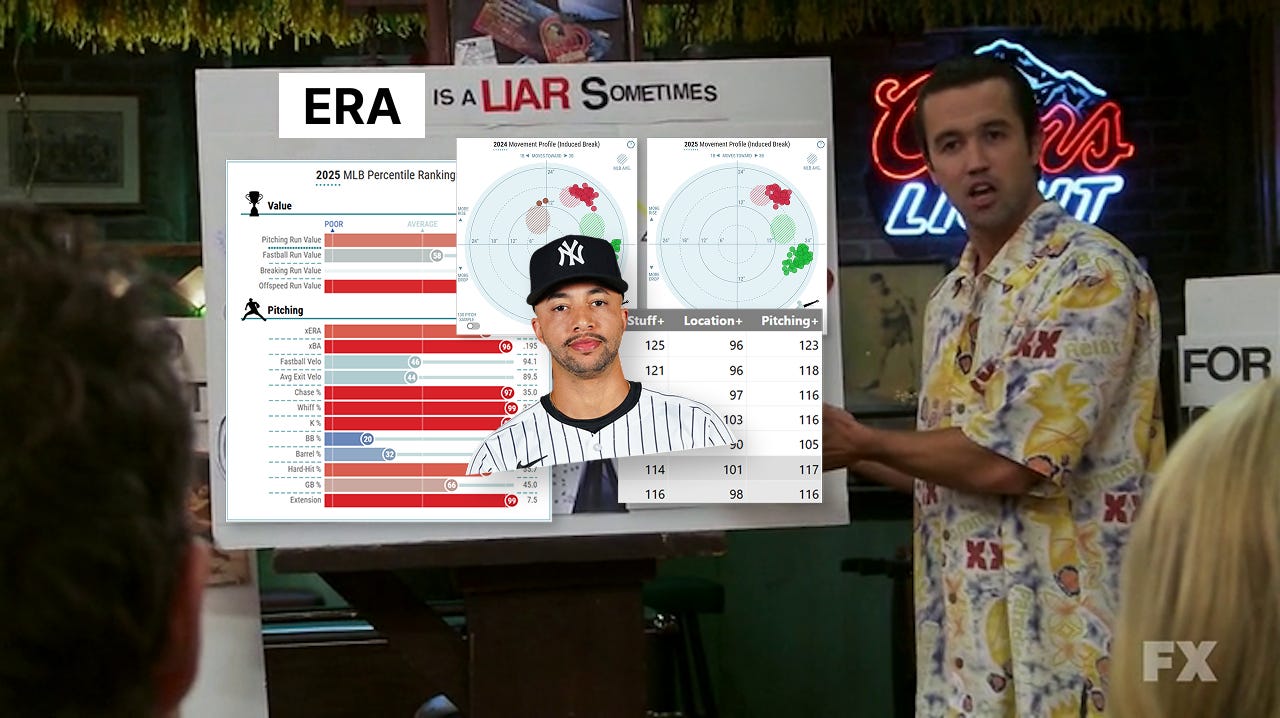
When I initially sat down to write this piece, I was starting a very different project.
I had originally planned to do a big wrap-up about the value of Edwin Díaz and Pete Alonso and what replacing them would potentially look like. No stranger to Mets fans, nor to David Stearns, current Yankees reliever Devin Williams was just going to be one of several replacement options — some of whom I’ve already written about — that have my eyebrows raised heading into the offseason.
But then, I started digging…and then, I kept digging.
Here’s how Williams’s 2025 stacked up against the likes of Edwin Díaz and some of those other relievers I’ve got my eye on:
Williams’s numbers are weird as hell, right?
A 4.79 ERA alongside a 2.68 FIP is crazy. That’s an absurd discrepancy; Williams’s ERA-FIP difference of 2.11 was the league’s largest among qualified relievers. It’s especially jarring when you consider that his career discrepancy is null: 2.45 ERA, 2.45 FIP.
Despite a relatively elevated WHIP, he posted the second-lowest walk rate of his career, and he was eliciting elite whiff/chase rates.
Even though his 34.7% K rate reflected a steep dip from the ~40% baseline he established from 2020-2024, it was still good for eighth-best in MLB.
Call me crazy…I think Williams was actually good last season. The peripherals agree.
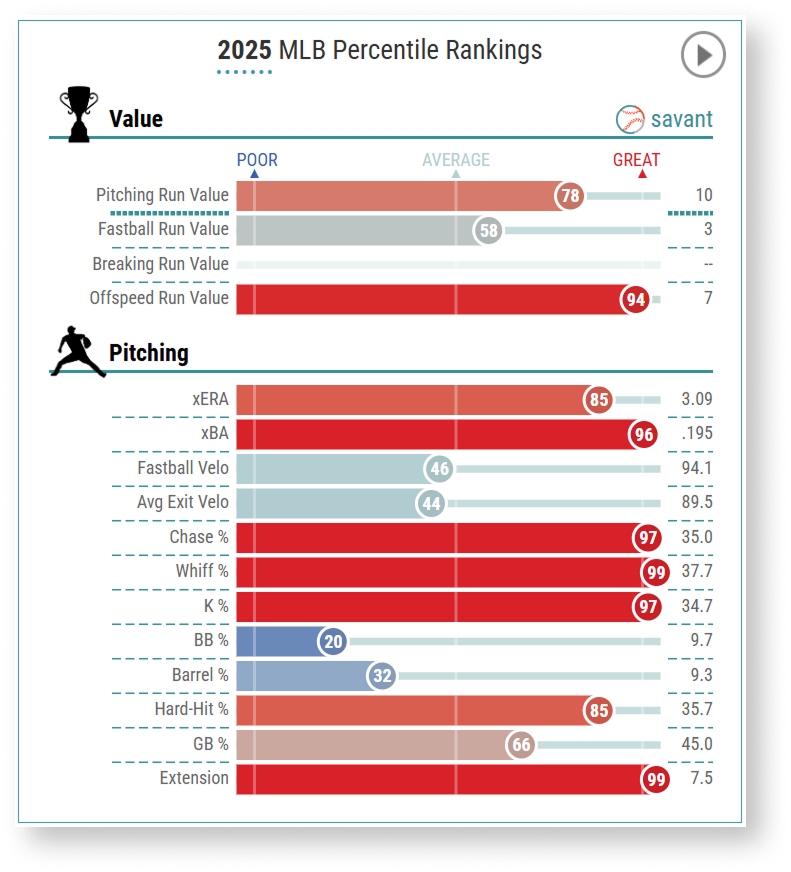
Not what you may have expected from Mr. 4.79, right?
Let’s hit on that for a moment. I’m sure I’m preaching to the choir here, but it bears repeating: while ERA is a decent indicator of pitcher effectiveness, it lacks a lot of context, and punishes pitchers for things beyond their control. It can also be severely exaggerated by a small sample size, which is a particular concern when evaluating relievers. That’s why it’s crucial to use a multitude of pitcher-specific metrics (FIP, K-BB%, strikeouts-minus-baserunners, etc.) to properly measure their performance.
Though Williams’s ERA last season ranked 136th out of 147 qualified relievers, he ranked 18th in FIP. We already covered his top-10 strikeout percentage, but his 25.1% K-BB% was also good for 13th in his group. Taking it a step further, Williams struck out 90 batters last season while allowing 76 baserunners. That +14 strikeout-minus-baserunner (SMB) ratio is one shy of, wouldn’t you know it, Emilio Pagán, good for 16th in MLB among relievers with at least 20 innings pitched in 2025.1
Clearly, he was more successful than his inflated ERA would have you believe.
As for what specifically contributed to that earned run explosion, Will Sammon did a fantastic breakdown for The Athletic. I’ll summarize here:
Over 62.0 innings in 67 appearances (both career highs), Williams allowed 33 runs, with 16 coming in just five of those 67 games.
There was a week in August in which Williams gave up three homers on his changeup to lefties, two of them with runners on.
Williams gave up 21 of his 33 allowed runs in 2025 in just twelve innings, all against lefties with RISP.
If that seems hyperanomalous, that’s because it is: this has never been a split he’s struggled with. Sammon continued that lefties slugged .468 with RISP against Williams in 2025; from 2019-2024, they slugged .276. Similarly, Williams’s 2025 lefty strand rate was 38.2%; his career mark beforehand was 87%.
Still, just as quickly as it started to spiral out of control, it was corrected. Williams made some mechanical adjustments in early August (largely, slowing down his delivery), and results followed immediately, both against lefties and in general:
Pre-8/10: 44.0 IP, 5.73 ERA, 3.64 FIP, 56 K-19 BB (29.6%-10.1% K-BB%), 1.23 WHIP
Post-8/10: 18.0 IP, 2.50 ERA, 0.36 FIP, 34 K-6 BB (48.6%-8.6% K-BB%), 0.89 WHIP
Williams himself summarized it pretty perfectly: “It’s not that I was bad all year, it’s just that when I was bad, I was terrible.”
Outside of the typical counting stats, it’s important to look at a pitcher’s ‘stuff’ when assessing their performance. Numbers tell you plenty, but how a repertoire actually plays on the field obviously carries significant weight as well. Lucky for us, some very smart people have figured out how to put numbers to what our eyes and box scores are already telling us.
For the unacquainted, here’s a simplified breakdown of how ‘Stuff’ scoring works (for a full explainer, head to FanGraphs):
‘Stuff+’ measures the physical attributes of a pitch, including but not limited to its release point, velocity, vertical and horizontal movement, and spin rate.
‘Location+’ assesses a pitcher’s general ability to ‘correctly’ place a pitch based on count and pitch type.
‘Pitching+’ uses the physical characteristics, location, and count of each pitch to try to judge the overall quality of the pitcher’s process.
Let’s see how Williams’s ‘stuff’ played in 2025:
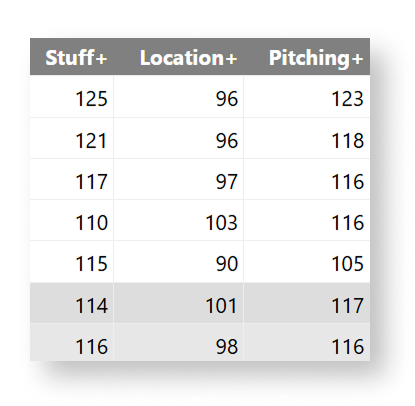
According to the numbers, his pitches were moving just as much as they have been the last few seasons, and his pitch selection and placement were, overall, better than at almost any other point in his career. This dude may have had one of the unluckiest seasons ever recorded.
Let’s look at Williams’s movement profiles from 2024 and 2025 side-by-side:
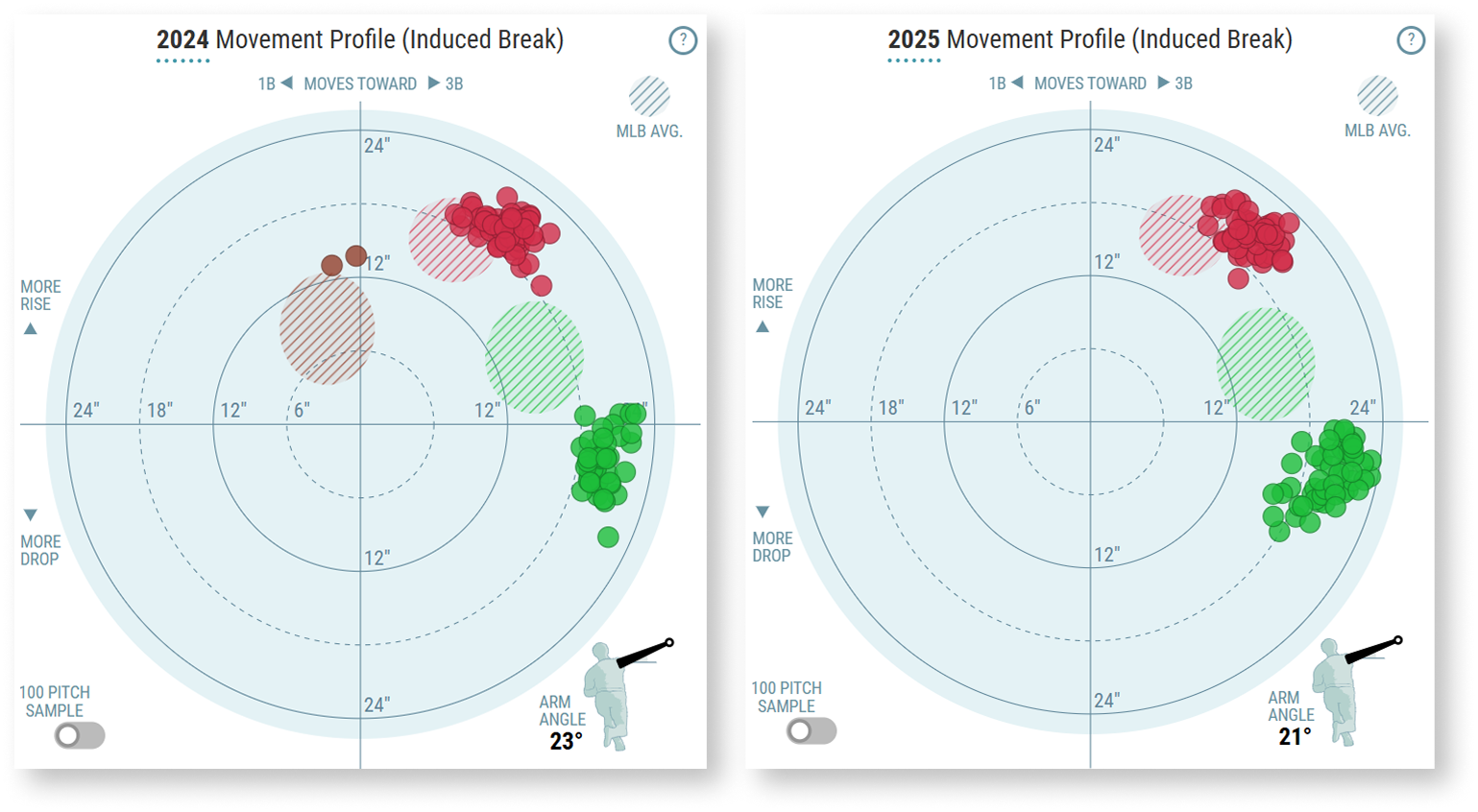
Something interesting here: Williams dropped his arm angle by two degrees. Though this may not seem like a huge deal (or even atypical, as he’s dropped his arm angle by at least one degree every year since he entered the league), even a slight adjustment in attack angle can significantly influence the shape and trajectory of a pitch. Typically, a lower arm angle means more arm-side run on fastballs and breaking stuff that works almost exclusively down in the zone; a two-degree drop in arm slot explains the uptick in lateral movement on his fastball in 2025. (I wonder if that slot-lowering trend will continue each year until he goes full submariner...)
Additionally, though the shape of his changeup was largely the same, he initially had some issues spotting it effectively; notice how there’s much more movement in towards the plate in ‘25 than in ‘24. As devastating as the airbender can be, if it doesn’t get its full break, it can turn into a sitting duck very quickly — hence those pesky lefty homers I mentioned. Still, once he addressed that issue, it stayed fixed.
Let’s look at both pitches really fast. First up, the fastball:
Sheesh. When it’s on, it’s on.
After getting off to a ‘flat’ start with it last season, Williams eventually found his groove with his fastball, as he used it more (47% vs. ~37% from ‘21–’23) and it featured more action (12.8 inches of break) than in recent seasons. While his heater may not overpower hitters with velocity, its movement more than compensates.
The drop in his arm angle I mentioned seems to have instantly boosted his arm-side run by nearly two inches, from roughly 10–11 inches in previous years to about 13 inches in 2025. That late break makes a seemingly middle-middle fastball dart away from lefties and in on righties’ hands just as it reaches the plate, which makes it very difficult to barrel up consistently. Its zone-spreading shape makes it a perfect tunneling weapon alongside Williams’s famed changeup.
Speaking of which, let’s get into the ‘Airbender.’
LOLLLL this pitch is so gross.
Williams’s signature pitch is genuinely unlike anything else in baseball. This pitch averages a ~2750 RPM spin rate, totally unheard of for a changeup. Typically, changeups are low-velo/low-spin pitches that maximize horizontal movement while staying down in the zone. For comparison, David Peterson’s changeup averages ~1700 RPM; Clay Holmes’s clocks in at just ~1100.
I’ve discussed spin rate before, but upon examining Williams’s spin efficiency data, the actual story here lies specifically in his ‘active spin’ data. Not all of a pitch’s spin actually influences its flight path. When looking at pitch shape and movement, there are two types of spin to consider: active spin and gyrospin. Active spin, also known as ‘transverse spin,’ refers to the actual movement directly created by a pitch’s RPMs. Gyrospin, meanwhile, is the stabilizing force behind the ball, influencing how predictably a pitch breaks and disrupting hitters’ timing.
Here’s what Williams’s primary pitches bring to the table:
Fastball: 2368 RPM, 97% active spin
Changeup: 2742 RPM, 87% active spin
Essentially, Williams is throwing two pitches that look nearly identical out of the hand despite having completely different shapes and velocities.
The fastball is thrown like the average fastball: high velo, high spin efficiency. It’s the airbender’s unique combination of high spin rate and relatively high active spin that helps it maintain the fastball illusion as it approaches the plate, only to leave hitters swinging early and over the ball as it tumbles through the zone. Williams’s 7.5 feet of extension (nearly a foot more than the rest of the league) only makes this pitch combo more nightmarish, as hitters are left with virtually no time to make a well-informed swing decision.
In summary, Williams may only throw two pitches, but that’s all he needs when they’re working to their full potential.
Here’s what they look like thrown in the same at-bat:
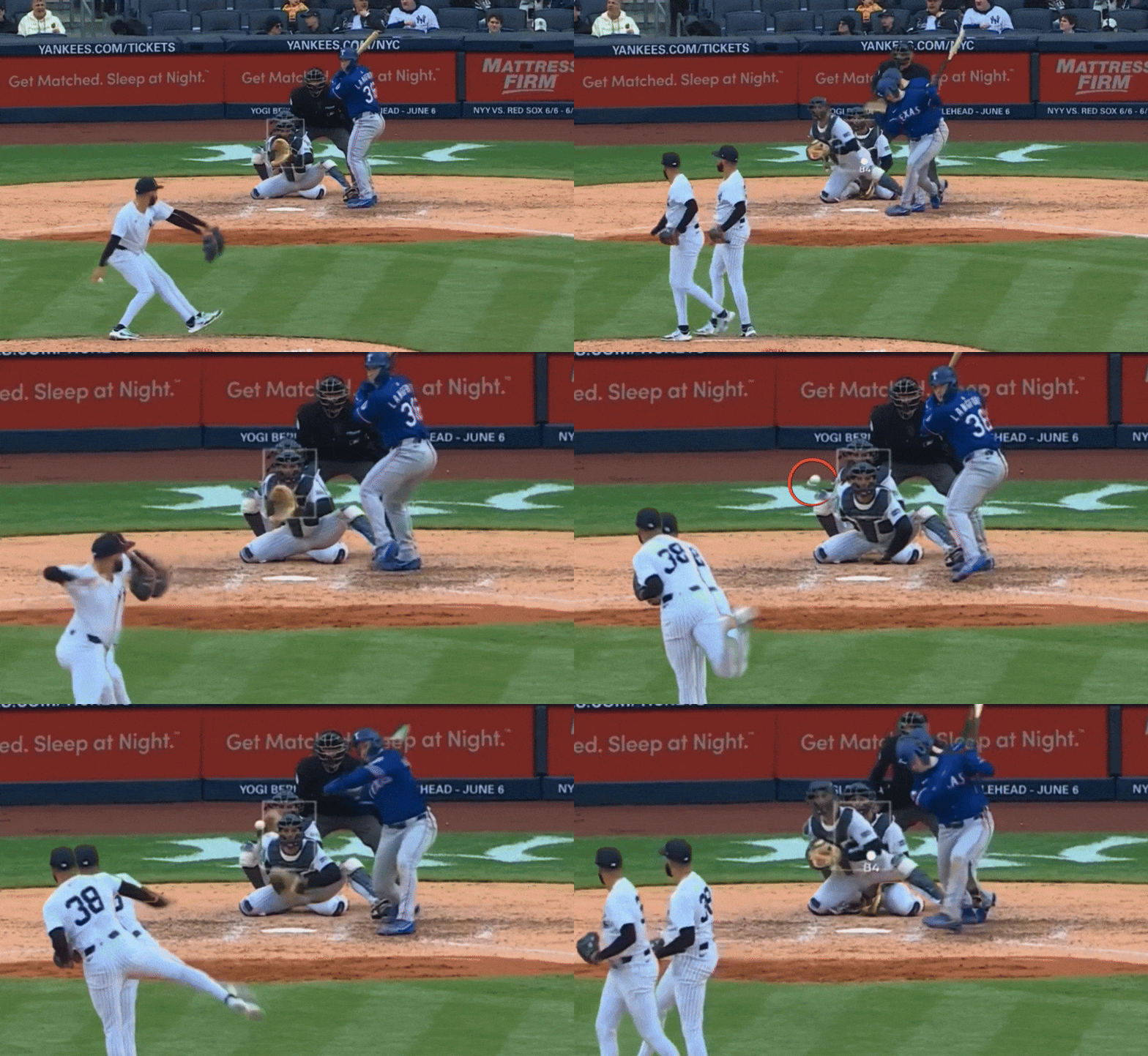
Just look at how perfectly tunneled those pitches are before they part ways. It’s art.
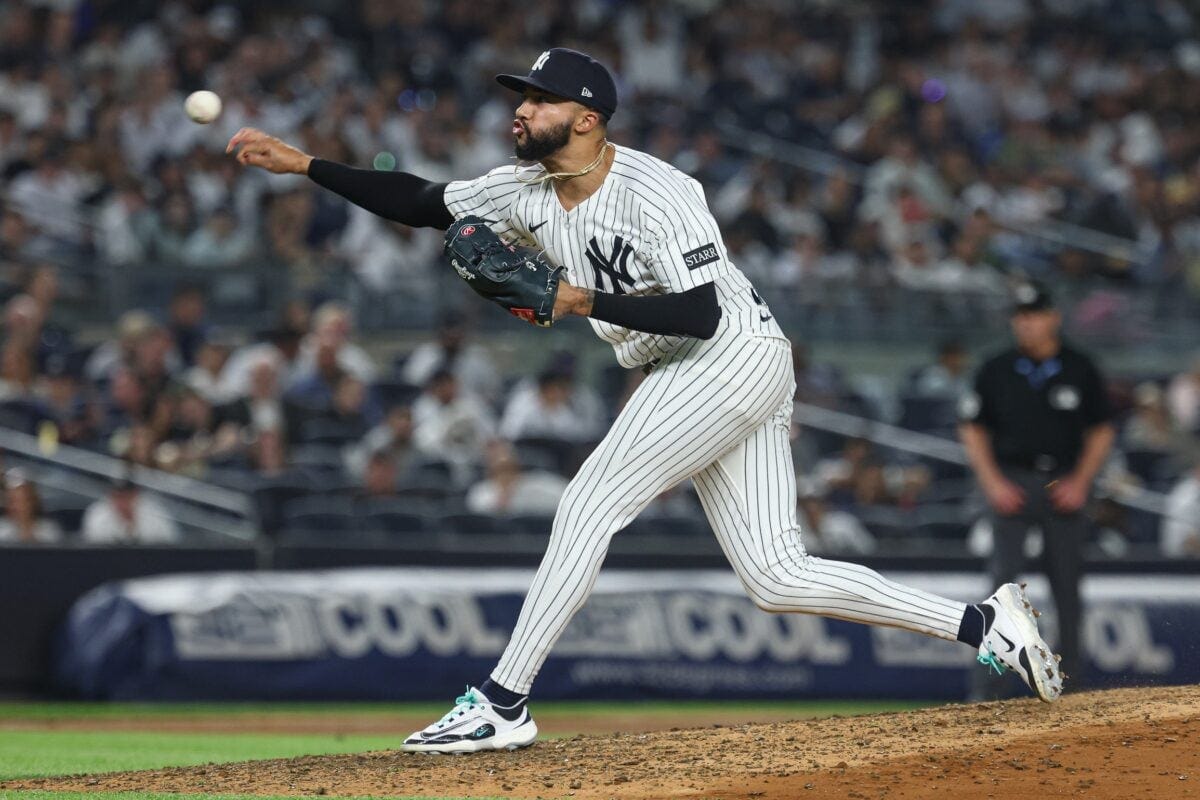
So, should the Mets make a run at Williams? I say yes, whether they keep Díaz or not.
There are various contract estimates out there for Williams right now — I’ve seen everything from one year/$18 million to four years/$68 million. I’m going to predict something directly down the middle: two years, $35 million.
Yes, an 85 ERA+ is an ugly number to see on anyone’s stat sheet, let alone an elite reliever’s. Yes, his initial performance in New York got off to a less impressive start than anticipated…but that doesn’t feel like a massive hurdle to me. Williams himself said he loved playing and living in the city and was appreciative that he got to experience both ends of the fan spectrum. Something tells me he’d fully rediscover his stride on our side of town; it’s worth remembering that both American Family Field and Citi Field grade out more favorably for pitchers by Park Factor (97 and 98, respectively) than Yankee Stadium does (100).
(That last point only means so much, of course…but it also feels like yet more evidence that he’s an ideal Change of Scenery candidate. Perhaps the grass is indeed greener just a few boroughs away.)
Despite last season’s statistical blips, Williams should be considered a Top 5 free agent relief option this winter. A two-time All-Star and two-time NL Reliever of the Year, he’s been a steady bullpen presence for his entire career. I have full confidence that his strong ending to 2025 is a trend that will persist into 2026, wherever he lands.
Where do you think Devin Williams will be playing next spring? Should the Mets extend an offer? Leave a comment below!
Shoutout to Baseball Spreadsheets for this little nugget — go read their full piece about SMB when you’re done with this!
I'm afraid Williams will become another Helsley case...
Diaz is first and foremost the guy that needs to comeback. If Edwin does comeback Williams wouldn’t be an option as Stearns isn’t going to spend that type of money for another arm. He goes cheap back there until he sees how it goes until the trade deadline.